
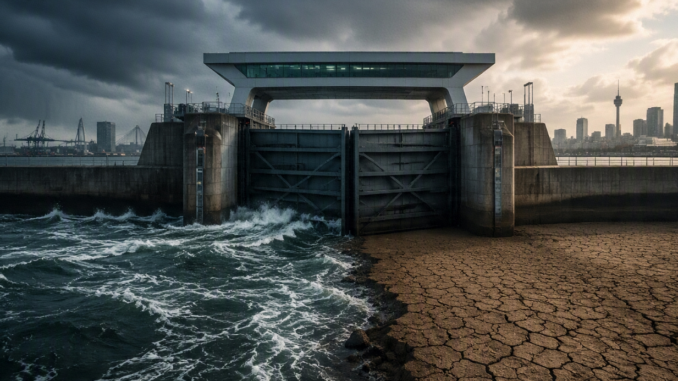
Sometimes it is unassuming news reports that reveal a profound change: In early August 2026, the Dutch water authorities decided to close all locks along the Nieuwe Maas between Rotterdam and The Hague to commercial and recreational shipping. At the same time, businesses, municipalities, sports clubs, and private households were prohibited from withdrawing surface water. The reason was not flooding, but the opposite: an exceptionally prolonged drought.
Because the Rhine was carrying only a small amount of freshwater toward the North Sea, saltwater was penetrating further and further inland. Every time a lock was opened, more saltwater would have entered the sensitive freshwater system. The closure was intended to prevent drinking water reservoirs, agricultural land, and industrial water withdrawals from being permanently compromised. According to Dutch authorities, these measures are unprecedented in this form.
The story lasted only a few minutes on the evening news. Its significance, however, extends far beyond the Netherlands—because Rotterdam is not just any port. It is the logistical heart of Europe. Millions of metric tons of raw materials, energy sources, food, and industrial goods pass through its locks every year. When drought there restricts the operation of key hydraulic structures for the first time, it fundamentally changes our perspective on the impacts of climate change.
Climate change no longer affects only individual regions or individual structures. It is beginning to put entire infrastructure systems under pressure simultaneously. This is precisely where the real paradigm shift lies. For decades, roads, bridges, railways, dikes, and locks were designed for clearly defined loads. Flood protection systems safeguarded against flooding. Roads were built for traffic. Locks regulated water levels. Today, these same structures must simultaneously cope with heat, drought, heavy rainfall, low water levels, rising sea levels, and increasing salinization.
Engineers are therefore increasingly referring to a multi-hazard approach. Planning is no longer determined by a single extreme event, but rather by a structure’s ability to respond flexibly to a wide variety of stresses. This realization is transforming the very nature of construction.
In the past, the central question was: How do we protect infrastructure from water?
Today, it is: How do we protect infrastructure simultaneously from water—and from the lack of it? This new way of thinking now shapes nearly all areas of infrastructure construction. Dikes are being fitted with internal retaining walls made of steel or mineral composite systems that remain stable even when prolonged drought causes the earthen embankment to shrink. Road surfaces are being designed to be more heat-resistant, bridges are monitored with digital sensor systems, and rail infrastructure is being adapted to withstand higher temperature stresses. At the same time, “sponge cities,” green traffic areas, and retention basins are emerging—these no longer drain water as quickly as possible but instead store it strategically and use it to cool cities.
This is no longer just about technical progress
Climate resilience is emerging as a key economic competency for modern industrialized nations. Infrastructure determines whether supply chains function, companies invest, insurance risks remain manageable, and regions remain competitive. Anyone planning a port, a rail line, or an industrial area today is no longer building for the climate of the past, but for a climate that will continue to change.
Perhaps this is the most important insight of recent years
Climate change does not destroy infrastructure solely through spectacular natural disasters. It is gradually altering the very conditions under which infrastructure can function at all. The closure of the locks in Rotterdam is therefore far more than just a regional news story. It marks a moment when it becomes clear that climate resilience is no longer merely an additional environmental task. It is becoming the foundation of economic stability, technical safety, and social preparedness in the 21st century.