
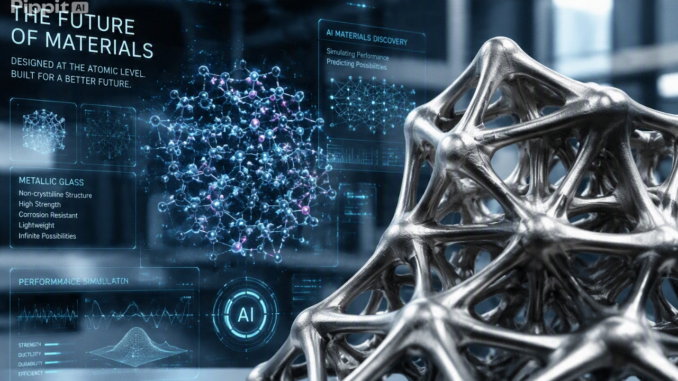
Artificial intelligence, the energy transition, and digitalization are widely seen as the great drivers of technological change. Yet behind many of these developments lies a more fundamental question: What materials will we use to build the future?
A drop of metal floats weightlessly in space. On the International Space Station, it is expected to behave in ways that would be difficult to reproduce on Earth. A research team from Saarland University plans to observe how its structure changes, how it solidifies, and what properties emerge in the process. The subject of the experiment is metallic glass—a class of materials whose internal structure differs fundamentally from that of conventional metals.
The experiments are scheduled to take place aboard the ISS from August 31 through September 4, 2026. Among other things, the data could help researchers design alloys more precisely for metal 3D printing. Unlike conventional metals, metallic glasses do not have an ordered crystalline structure. In the future, they could be used for complex, highly stressed 3D-printed components in aerospace, medical technology, and mechanical engineering.
At the same time, computer programs are searching for materials that have never been made before. Artificial intelligence is combing through millions of possible atomic combinations, simulating their properties and suggesting new compounds. In Aachen, a young company is working on graphene-based materials for the next generation of semiconductor technology. In Osnabrück, researchers are developing aerogels from sustainable raw materials—extremely lightweight materials with exceptional insulating properties. Elsewhere, scientists are trying to produce plastics from agricultural residues, reuse carbon fibers, and develop materials capable of adapting to their surroundings.
What connects these developments is more than the search for the next technological breakthrough. It represents a fundamental shift in the way we think about matter itself. The major technologies of the coming decades will not be determined by better software, more powerful computers, or new machines alone. They will also depend on whether we can develop materials that withstand higher temperatures, weigh less, last longer, store energy more efficiently, are easier to recycle, or possess properties that simply did not exist before. The next industrial revolution may therefore begin in a place that is surprisingly often overlooked in the great debates about the future: with the material itself.
Every Technological Era Had Its Materials
The idea is older than it may seem. Entire periods of human history bear the names of the materials that defined them: the Stone Age, the Bronze Age, the Iron Age. That is no coincidence. Learning to master a new material often transformed far more than individual products. It changed production methods, trade routes, military power, and social structures. Bronze enabled tools and weapons that could not be made from stone. Iron transformed agriculture and warfare. Steel became the material of industrialization—for railroads, bridges, machines, and cities. Silicon, in turn, laid the foundation for microelectronics and, with it, the digital world.
Today, the Picture Is More Complex
There is no longer a single material capable of giving an entire era its name. But that may be precisely where the real revolution lies. We are entering an age in which materials are increasingly engineered for specific functions. The question is no longer simply: Which material is suitable for this application? It is increasingly becoming: What properties must a material have—and how can we design its structure so that it has them?
Nobel Prize-winning physicist Konstantin Novoselov, who shared the prize with André Geim for pioneering experiments on the two-dimensional material graphene, embodies this development. Graphene is a two-dimensional form of carbon consisting of a single layer of carbon atoms arranged in a honeycomb pattern. Research into two-dimensional materials has shown that reducing materials to atomically thin layers can unlock entirely new physical properties and functions. Combining different atomic layers can also create so-called van der Waals heterostructures, enabling functions that conventional material systems cannot provide. The future of materials science is therefore increasingly not just about discovering materials that already exist. It is about designing matter itself.
The Digital Revolution Has a Physical Foundation
One of the great misconceptions of our time is to treat digitalization and materials science as separate worlds: Artificial intelligence appears immaterial. So does cloud computing. Data travel through fiber-optic cables, while algorithms exist as mathematical structures. Yet every digital application ultimately depends on highly complex physical systems: semiconductors, electrical circuits, sensors, memory, batteries, cooling systems, and optical connections. The more powerful the digital world becomes, the greater the demands it often places on the materials supporting it. This is particularly true of artificial intelligence.
Modern AI systems require enormous computing capacity. Data must move ever faster between chips, memory, and processing units. That generates heat, energy losses, and technological bottlenecks. Advances in computer science are therefore increasingly running into physical limits. And that brings us back to the question of materials.
Graphene has become a symbol of this new world of materials since its discovery. Klaus Schwab, founder of the World Economic Forum, coined the term “Fourth Industrial Revolution.” He explicitly includes advanced materials among the physical innovations driving this transformation. In his work, Schwab describes new materials as lighter, more stable, more adaptable, and increasingly recyclable, highlighting graphene in particular for its exceptional mechanical and electrical properties.
The importance of such materials lies not merely in making existing products somewhat better. The more fundamental question is: What technologies become possible when the properties of the materials themselves change? That is where the new generation of materials research begins.
From Finding Materials to Designing Them
For a long time, materials development followed a relatively straightforward pattern. Scientists developed a hypothesis, produced a sample, tested it, and then modified its composition or manufacturing process. The process could take years. That will probably not fundamentally change: materials science will remain an experimental discipline. But the speed is changing.
Computers can now simulate how atoms might behave in particular structures. Databases capture the properties of known materials. Machine learning can identify patterns that might remain invisible to a human researcher. Artificial intelligence can screen millions of possible chemical combinations and substantially reduce the number of experiments that actually need to be performed.
The Development of Materials Is Becoming Digital
This is more than a new research method. It is changing the industrial clock: Traditionally, many years can pass between a scientific idea and a market-ready material: discovery, synthesis, analysis, optimization, scaling, processing, certification. If the earliest stage can be accelerated substantially, the consequences could extend across entire industries. The race for new materials is therefore increasingly becoming a race for data, computing power, artificial intelligence, and automated laboratories. The material of the future may no longer be discovered only in a laboratory. It may first exist as a mathematical model.
Sustainability Becomes a Material Property
But technological progress can no longer be measured simply by whether a material is stronger, lighter, or more heat-resistant. An increasingly important question is: What are the consequences of its entire life cycle? Where do its raw materials come from? How much energy does manufacturing require? How long will the product last? Can it be repaired? Can it be recycled? Does its use or disposal create new risks? Sustainability is thus becoming a central dimension of materials development itself.
An extremely lightweight material may save enormous amounts of energy during use while requiring large amounts of energy to manufacture. A bio-based material may replace fossil resources but become difficult to recycle if it is poorly designed. An exceptionally durable composite may conserve resources for decades yet present a difficult problem at the end of its life when its different components need to be separated. The materials revolution will therefore not succeed simply by creating new properties. It must also correct the failures of earlier material cycles.
The history of plastics is a lesson in this regard
Few materials transformed everyday life in the 20th century as comprehensively as plastics: lightweight, moldable, inexpensive, durable, and suitable for countless applications. That success, however, also created a global waste and environmental problem. The next generation of materials therefore faces a higher standard: They must deliver greater performance without creating the same scale of new dependencies and environmental liabilities.
Germany Can Do the Research. But Can It Build the Markets?
For Germany and Europe, this development has particular strategic importance: Germany has an exceptionally broad research base in chemistry, physics, engineering, and materials science. Fraunhofer and Max Planck institutes, universities, and industrial research centers are working on battery materials, photovoltaics, hydrogen technologies, advanced ceramics, biomaterials, semiconductors, and materials designed for the circular economy.
Research Alone Does Not Determine Economic Success
Between a spectacular material property and an industrial product lies a long road. A new material must be manufactured reproducibly. It must be affordable. Machines must be able to process it. Its properties must remain reliable over many years. In many fields, extensive testing and regulatory approval are required. Then customers have to be convinced, supply chains established, and production capacity built. A scientific breakthrough does not automatically become industrial value creation.
For Germany, this may be the decisive question: Can we not only research the next generation of materials, but also develop them, manufacture them, and bring them into industrial markets? That will determine whether materials research remains a scientific success story—or becomes the foundation for a new generation of industrial value creation. For companies developing advanced materials, and for those helping technologies make the difficult journey from laboratory concept to industrial application, this is not an abstract question. It is the real challenge.
The Future Has No Single Color
Perhaps that is why no one looking back a hundred years from now will speak of our era as the Age of Graphene, the Age of Lithium, or the Age of Biomaterials. The developments are simply too diverse. The new materials world is becoming a growing mosaic: atomically thin layers, ceramic matrix composites, metallic glasses, programmable polymers, bio-based plastics, intelligent surfaces, recycled carbon fibers, advanced semiconductors, and materials discovered with the help of artificial intelligence. What connects them is not their chemical composition. It is something deeper.
A New Way of Thinking About Matter
Human beings are increasingly moving beyond simply using materials as nature provides them. We are learning to understand their structures at ever-smaller scales and to modify them with increasing precision. Atomic layers are combined. Fibers are embedded in ceramic matrices. Biological processes are used to manufacture chemical building blocks. Computer models calculate properties before the first physical sample exists. This does not merely change individual products. It changes our understanding of what is technically possible.
The Transformation Is Also a Material One
The great industrial transformation of the coming years will undoubtedly be digital. It will be shaped by artificial intelligence, robotics, and connected systems. It will also be biological, as cells, enzymes, and microorganisms open new pathways for production. But it will also be—and perhaps more fundamentally than we realize today—material. Because ultimately, every technology must take physical form.
A computer needs a chip. A battery needs electrodes and electrolytes. A wind turbine needs high-performance composite materials. A solar installation needs functional semiconductor layers. A turbine needs materials capable of withstanding extreme heat and mechanical stress. And even the most sophisticated artificial intelligence depends on an infrastructure of cables, data centers, sensors, and machines. The future will be calculated, programmed, and connected.
But it will be built from materials.